 How-to
How Do You Plan a Group Dinner Event That Works?
Last Updated: October 28, 2026
Quick Summary
To plan a group dinner that works, first define the purpose, tone, and guest list before booking anything, then work backward from the event date with a checklist covering budget, venue, RSVPs, and menu. Collect dietary needs on the RSVP, confirm venue capacity and headcount deadlines in writing, and set money rules before the event.
- Set your date, budget, and guest list 6-8 weeks before the event.
- Ask about allergies and dietary needs directly on the RSVP itself.
- Set the RSVP deadline a full week before you need the final count.
- Confirm in writing whether a deposit counts toward the final bill.
- Build a one-page event-day sheet with venue contact and backup plans.
Table of Contents
- Start With the Purpose, Tone, and Guest List
- Your Group Dinner Planning Checklist, Step by Step
- How to Manage Dietary Restrictions at a Group Dinner
- Large Group Dinner Menu Ideas That Please a Crowd
- Group Dinner Invitation Wording That Gets Clear RSVPs
- Budgeting, Deposits, and Splitting the Bill Fairly
- Seating, Ambiance, and Keeping the Conversation Flowing
- Contingency Planning for Your Group Dinner Event
- Frequently Asked Questions
Start With the Purpose, Tone, and Guest List
Most group dinners go sideways before anyone picks a date. The reason is simple: the host never decided what the night is actually for.
Group dinner planning is the process of defining why you're gathering, who's coming, and how the evening should feel before you book anything. Get those three answers in writing, and every later decision gets easier.
Ask yourself:
- Is this a celebration, a work dinner, or a casual reunion?
- Do you want lively and loud, or quiet enough to actually talk?
- Who must be there, and who would change the room's mood?
The guest list drives everything downstream. A 10-person anniversary dinner needs a different room, menu, and budget than a 25-person team night. Nail down your event purpose and event tone first, then build the guest list from there.
Your Group Dinner Planning Checklist, Step by Step
A group dinner planning checklist turns a vague idea into a sequence you can actually work through. Here's the order we'd follow, from first decision to final follow-up.
- Define purpose, tone, and guest count
- Set a realistic budget per person
- Choose a date and build a timeline
- Book the venue and confirm capacity
- Collect RSVPs and dietary needs
- Finalize the menu and beverage service
- Plan seating, décor, and ambiance
- Confirm logistics and a backup plan
- Send reminders the week of
- Follow up after the event
For a deeper walkthrough of hosting at scale, our complete guide to hosting large group dinners covers the details that don't fit in a short checklist.
Set the Date and Build a Working Timeline
Work backward from your event date, not forward. A planning timeline gives every task a home and keeps advance preparation from collapsing into one frantic week.
- 6-8 weeks out: Set date, budget, and guest list
- 4-6 weeks out: Book the venue, send invitations
- 2-3 weeks out: Collect RSVPs and dietary requirements
- 1 week out: Confirm headcount with the venue
- 2 days out: Send a reminder with time and parking details
Pick a date that works for your core guests first. A date everyone can't make is a date that fails.
Lock In the Venue and Confirm Capacity
Venue capacity is the number one thing hosts get wrong. A room that seats 20 comfortably can feel cramped at 30, and noise levels rise fast as guest count climbs.
When you tour a space, ask:
- How many guests fit at one table versus scattered tables?
- Is there a private room, and does it have a minimum spend?
- How loud is the room when full?
- Is the space accessible for guests with mobility needs?
Confirm the headcount accuracy deadline in writing. Most venues need a final number a few days ahead, and that number usually sets your bill. If you're ready to secure a space, learn how to book a private dining room for your group.
Work backward from your event date so every task has a home.
| Timeframe | What to do |
|---|---|
| 6-8 weeks out | Set date, budget, and guest list |
| 4-6 weeks out | Book the venue, send invitations |
| 2-3 weeks out | Collect RSVPs and dietary requirements |
| 1 week out | Confirm headcount with the venue |
| 2 days out | Send a reminder with time and parking details |
How to Manage Dietary Restrictions at a Group Dinner
Dietary restrictions are not an afterthought, and handling them well is one of the clearest signs of a thoughtful host. Ask about food allergies and preferences on the RSVP itself, not after the menu is set.
A simple approach:
- Add a line to your RSVP: "Any allergies or dietary needs?"
- Group responses into categories: allergies, vegetarian, vegan, gluten-free, other
- Share the list with the venue or caterer early
- Confirm a safe option exists for every guest
Watch out: a severe allergy is not a preference. Treat nut, shellfish, and dairy allergies as safety issues, and confirm with the kitchen that cross-contact is managed. For guidance on food safety and allergen handling, the U.S. Food and Drug Administration publishes reference material on major food allergens.
Large Group Dinner Menu Ideas That Please a Crowd
The best large group dinner menu ideas share one trait: they're easy to serve and hard to dislike. Build a menu that covers a range of tastes without turning into a logistical puzzle.
A crowd-pleasing structure:
- Shared starters: items that travel well and don't need precise timing
- A main with range: one hearty option, one lighter option, one vegetarian
- Sides that scale: dishes that hold up on a buffet or family-style table
- A dessert everyone can share
Family-style menu planning keeps food quantity predictable and lets guests choose their own portions. If you're working with a caterer, ask how they handle meal preparation and food service for your headcount. At Pyke's Crossroads, our kitchen is 95% scratch and puts an imaginative twist on traditional home-cooked dishes.
Group Dinner Invitation Wording That Gets Clear RSVPs
Good group dinner invitation wording does one job: it gets you a firm yes or no by a deadline. Vague invitations produce vague RSVP counts, and vague counts wreck your venue and menu plans.
Include these details up front:
- What the event is and who it's for
- Date, time, and location
- Dress code, if any
- RSVP deadline and how to respond
- A line for dietary needs
Here's a template you can copy:
"You're invited to a group dinner on [date] at [time] at [venue]. Join us for [occasion]. Please RSVP by [date] by replying to this message. Let us know of any dietary needs or allergies. Dress is [casual/smart]. We can't wait to celebrate with you."
Set the RSVP deadline a full week before you need the final count. That buffer absorbs the stragglers who always reply late.
Budgeting, Deposits, and Splitting the Bill Fairly
Budget is where group dinners get uncomfortable, so decide the money rules before the event, not at the table. Start with a per-person cost estimate and build the total from there. A practical approach is to set a target range per guest first, then work backward into venue, menu, and beverage choices that fit inside it.
Plan for these line items, and expect the total to land well above the menu price once tax, gratuity, and venue fees are added:
- Food and beverage per guest
- Venue deposit or minimum spend
- Tax and gratuity (often 20% or more on the food and beverage subtotal for large parties)
- Décor or extras
- A small buffer for surprises
A common pattern is to build the budget in three tiers: a lean per-person target, a comfortable target, and a ceiling you will not exceed. Share the tier with the venue so they can propose a menu that fits rather than quoting the highest option first. If your group includes guests who may be cost-sensitive, state the expected per-person contribution in the invitation so no one is surprised at the table.
Deposits are common for private rooms and large parties, and many venues tie them to a minimum spend. Ask up front whether the deposit counts toward the final bill, whether it is refundable, and what the cancellation policy is. A deposit that is applied to the final bill is very different from a flat rental fee that is not.
For splitting the bill, pick one method and state it in the invitation:
- Even split: simplest, but unfair if some guests don't drink
- Pay for what you order: fairest, but slower at the table
- Host covers it: cleanest, if your budget allows
If you are collecting money before the event, set a clear deadline and a single collection method. A shared payment link or a simple spreadsheet that tracks who has paid prevents the awkward follow-up at the table. For groups where one person fronts the deposit, note the expected reimbursement in the invitation so the arrangement is transparent from the start.
Seating, Ambiance, and Keeping the Conversation Flowing
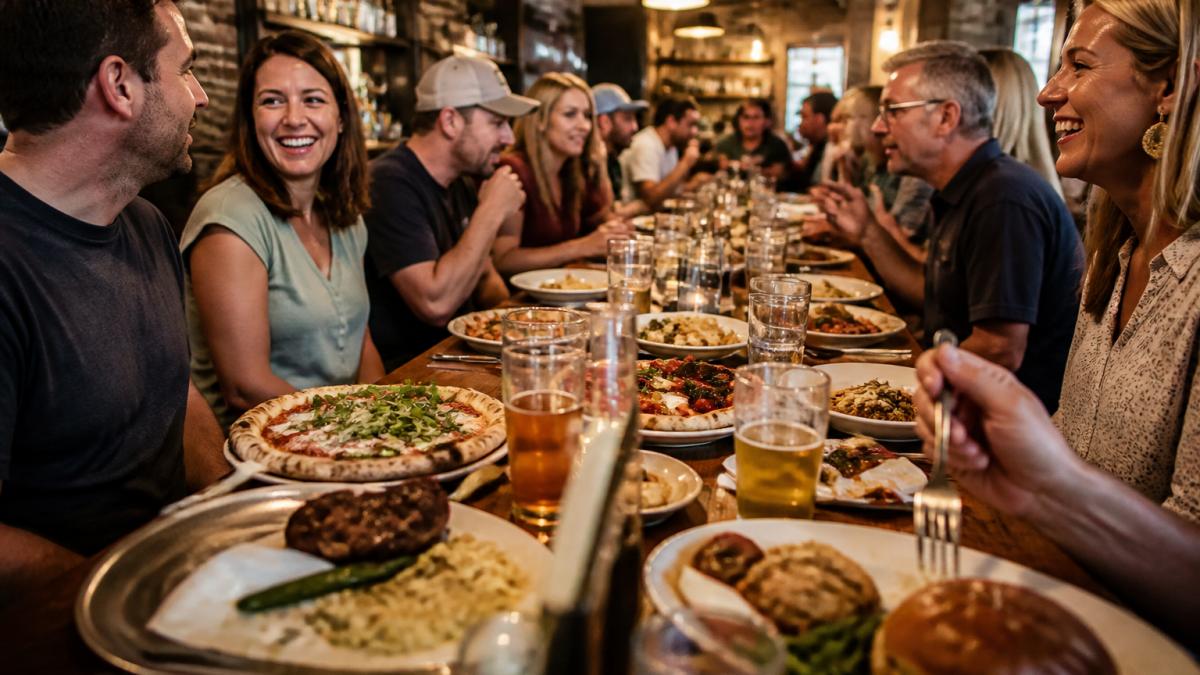
Seating arrangement and table layout quietly shape how well a group dinner goes. A thoughtful personality mix at each table keeps guest interaction lively and stops the evening from splintering into awkward pockets.
A few practical moves:
- Mix quiet and outgoing guests at each table
- Seat people with shared interests near each other
- Keep the head of the table for the guest of honor
- Use décor and warm lighting to soften the room
Music and entertainment set the tone, but keep volume in check so conversation stays easy. For added ambiance, browse the best places for live music in town. If you're weighing a relaxed venue, see these family friendly dinner spots where the group can settle in and talk.
Contingency Planning for Your Group Dinner Event
Contingency planning is the difference between a hiccup and a disaster. Build a backup for the things most likely to go wrong, and you'll handle them without drama. The goal is not to anticipate every problem but to have a decision already made for the handful of issues that actually happen at group dinners.
Your backup list should cover:
- A few guests dropping out at the last minute
- A guest revealing an allergy on arrival
- Running over your time slot
- A weather or travel delay
For each one, decide in advance who handles it and what the fallback is. If guests drop out, know whether your venue allows a lower final headcount and by what date. If an allergy appears on arrival, have the kitchen's point of contact ready and a safe default dish identified.
Confirm the cancellation policy in writing when you book. Know the cutoff date for reducing your headcount, whether the deposit is refundable, and what happens if a vendor cancels.
Event-day coordination runs smoother when one person owns the schedule and the venue has a single point of contact. That person should arrive early, confirm the room setup, and check that the dietary meals are labeled. A short pre-event call with the venue the day before catches most last-minute issues before they become problems.
Frequently Asked Questions
How far in advance should you plan a group dinner?
Start planning early enough to confirm a venue, collect RSVPs, and sort out dietary needs. If you are considering a private space or a set menu, check with the venue about its offerings before sending invitations.
How do you collect dietary restrictions from guests?
Ask on the RSVP itself, not after. Include a line like 'Please note any allergies or dietary needs' with your invitation, and give a firm reply-by date. Share the full list with the venue and ask about its ability to accommodate those needs.
How do you choose a restaurant for a large group dinner?
Match the venue to your event purpose first, then ask about capacity, menu options, and noise level. Ask whether the venue takes group reservations and whether it can accommodate dietary restrictions.
What is a good menu for a group dinner?
Consider a menu with options for different tastes and ask the venue about dietary needs. Pyke's Crossroads offers hand-crafted pizzas baked in wood-fired ovens and over 60 beers, with a focus on Texas-made craft brews.